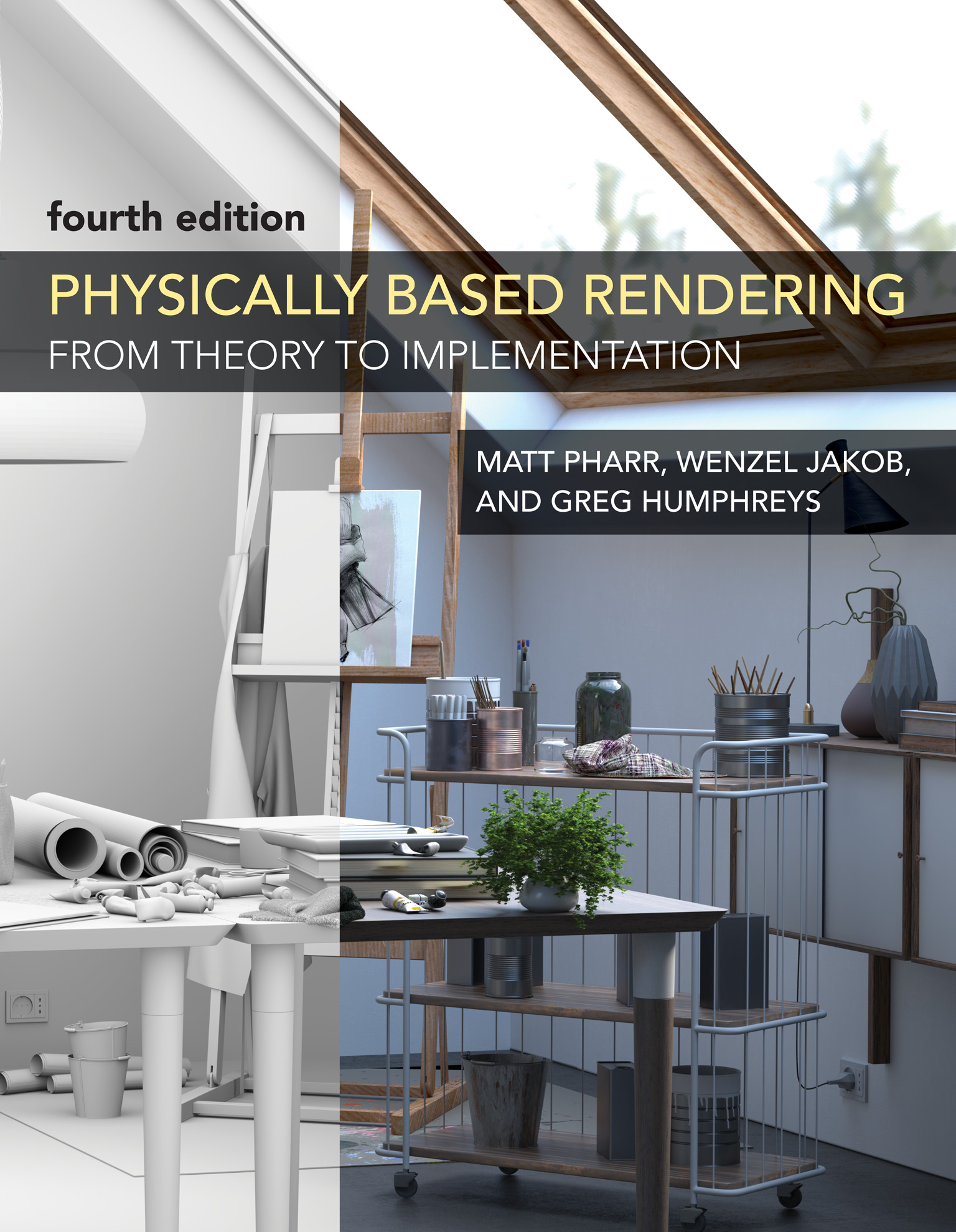
From movies to video games, computer-rendered images are pervasive today.
Physically Based Rendering introduces the concepts and theory of
photorealistic rendering hand in hand with the source code for a sophisticated
renderer. By coupling the discussion of rendering algorithms with their
implementations, Matt Pharr and Greg Humphreys are able to reveal many of the
details and subtleties of these algorithms. But this book goes further; it also
describes the design strategies involved with building real systems—there
is much more to writing a good renderer than stringing together a set of fast
algorithms. For example, techniques for high-quality antialiasing must be
considered from the start, as they have implications throughout the system. The
rendering system described in this book is itself highly readable, written in a
style called literate programming that mixes text describing the system
with the code that implements it. Literate programming gives a gentle
introduction to working with programs of this size. This lucid pairing of text
and code offers the most complete and in-depth book available for
understanding, designing, and building physically realistic rendering
systems.
For a preview, download Chapter 7, "Sampling and Reconstruction".
News
- October 12, 2009
-
We're having a contest to render the cover image for the second edition of
the pbrt book---the best image rendered with pbrt submitted by December 1
will be featured as the image on the cover of the book. (See the
full contest rules for more information.)
We are also looking for excellent rendered images to help show off concepts
like depth of field, indirect lighting, caustics, subsurface scattering,
etc. Contact authors at pbrt dot org if you have an image you'd
like to submit for these purposes.
- October 7, 2009
-
An alpha release of pbrt version 2.0 has been released; see
the readme file for more information. This
version of the system corresponds to the version that will be described in
the second edition of the book, which is expected to be available in August
2010. The system can be downloaded
from the pbrt github page,
either by clicking the "download" button or by using
the git SCM system.
- July 27, 2009
-
pbrt 1.04 is released: a number of bugs and incompatabilities have been fixed.
Get it from the downloads page.
- June 28, 2008
-
luxrender, a GPL Open Source
fork of pbrt, has released version 0.5 with many new features, including
full spectral rendering, bidirectional path tracing, a hierarchical
material and texture system, displacement mapping, and much more.
- November 18, 2007
-
Check out luxrender, a GPL Open Source
fork of pbrt. The project seems to be off to a strong start and there are some
amazing images in the gallery.
- July 4, 2007
-
The long-awaited 1.03 patch release of pbrt has been released.
See the downloads page.
- August 12, 2006
- A number of cool new renderings have been added to the
gallery page.
- January 9, 2006
- Mark
Colbert has updated his
Maya plugin that
exports Maya scenes to pbrt and renders them inside Maya to both
support Maya under Windows and Maya under OS X.
- May 17, 2005
-
A Mathematica-to-PBRT exporter has been released.
See the downloads page.
- April 25, 2005
-
The long-delayed first patch release of the pbrt source code has been
released. This release fixes a number of bugs found by readers and
the authors in the first 6 months after the book's publication.
See the downloads page for links to the
source code and information about the fixes in this release.
- April 25, 2005
- A new photon mapping plugin, implmenting many improvements to the
photon mapping implementation described in the book, has been added
to the plugins page.
- February 14, 2005
- Physically Based Rendering
has won an Honorable Mention in in the Computer and Information Science category from
the The Professional and Scholarly Publishing Division of the Association of
American Publishers Awards. The award winners in each category were selected for
their unique contribution to scholarly publishing and are considered by the
panel of judges to be the best of the best for 2004.
- February 10, 2005
- A handy debugging integrator has been added to the plugins page.
© Copyright 2004-2007 Matt Pharr & Greg Humphreys. All rights reserved.